- Quizzoo
- Children's quiz questions and answers
- Quiz for 12 year olds with answers
Quiz for 12 year olds with answers
Flags that are easy to mix up, world capitals and element symbols that come from Latin. This is a quiz for 12 year olds with answers on the page, pitched at Year 7, and it sticks to things worth knowing. There are no film, music or sport rounds.
Play this quizFree to play. No sign-up, nothing to install.
Print this quiz (PDF)Answers (PDF)
Numbers
What is 1/4 of 120?
30. To find a quarter, divide by 4: 120 ÷ 4 = 30.
What is −2 + 3?
1. Start at −2 on a number line and count 3 to the right: 1.
Put these in order, smallest first: 0.8, 0.55, 0.35, 0.3.
0.3 → 0.35 → 0.55 → 0.8. 0.8 is the same as 0.80, so it is bigger than 0.55.
What is 7/10 of 90?
63. Find 1/10 first: 90 ÷ 10 = 9. Then 7 lots of 9 make 63.
What is 17 × 11?
187. 17 × 11 is 17 × 10 plus 17 × 1: 170 + 17 = 187.
True or false: 210 ÷ 21 = 21.
False. 210 ÷ 21 = 10. Think backwards: 10 × 21 = 210, so 210 ÷ 21 = 10.
True or false: 102 ÷ 17 = 6.
True. Think backwards: 6 × 17 = 102, so 102 ÷ 17 = 6.
What is 15 × 19?
285. 15 × 19 is 15 × 10 plus 15 × 9: 150 + 135 = 285.
What is 189 + 186?
375. Hundreds, tens, then ones: 100 + 100 = 200, 80 + 80 = 160, 9 + 6 = 15. Altogether: 375.
The world
True or false: This is the flag of Monaco.

True. It's Monaco. Monaco and Indonesia are both red over white. Monaco's flag is squarer.
True or false: This is the flag of Lebanon.
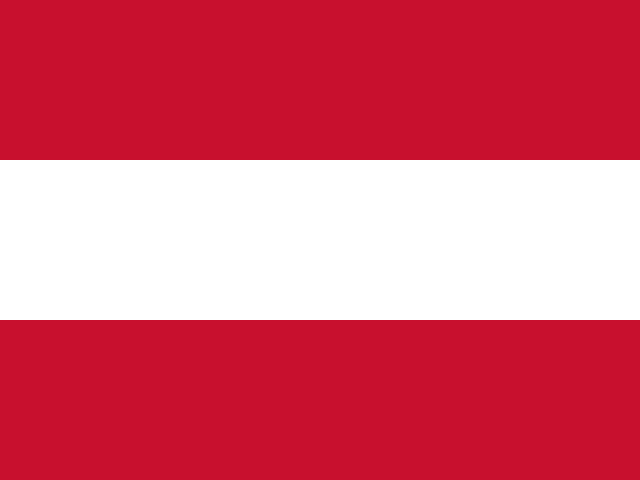
False. It's Austria. Austria's red, white and red flag is one of the oldest national flags in the world.
What is the capital of Trinidad and Tobago?
- Port of Spain
- Washington, D.C.
- Managua
- Nassau
Port of Spain. The steelpan, a drum made from an oil barrel, was invented in Trinidad and Tobago.
What is the capital of Kiribati?
- Port Vila
- Suva
- South Tarawa
- Palikir
South Tarawa. Kiribati is the only country with land in all four hemispheres: north, south, east and west.
Put these in order, oldest first: Big Ben, Space Needle, Terracotta Army, White House.
Terracotta Army → White House → Big Ben → Space Needle. Oldest first: Terracotta Army (about 210 BC), White House (1800), Big Ben (1859), Space Needle (1962).
What is the capital of Paraguay?
- Santiago
- Sucre
- Asunción
- Caracas
Asunción. Paraguay has two official languages, Spanish and Guaraní, and many people speak both.
True or false: This is the flag of Djibouti.
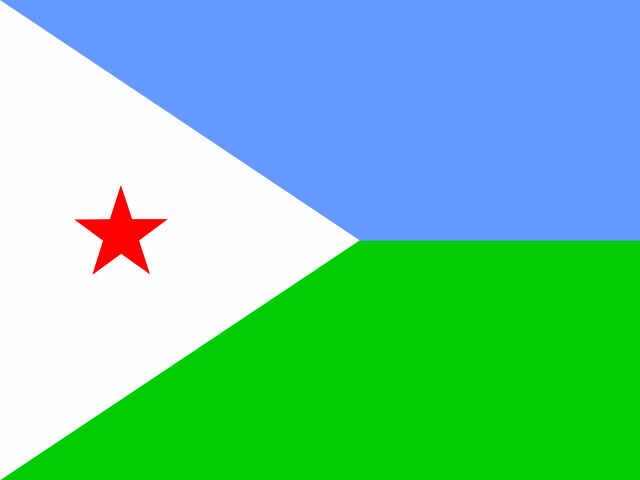
True. It's Djibouti. Lake Assal in Djibouti is the lowest point in Africa, more than 150 m below sea level.
Which continent is Nicaragua in?
North America. Nicaragua is the largest country in Central America.
Which country's flag is this?
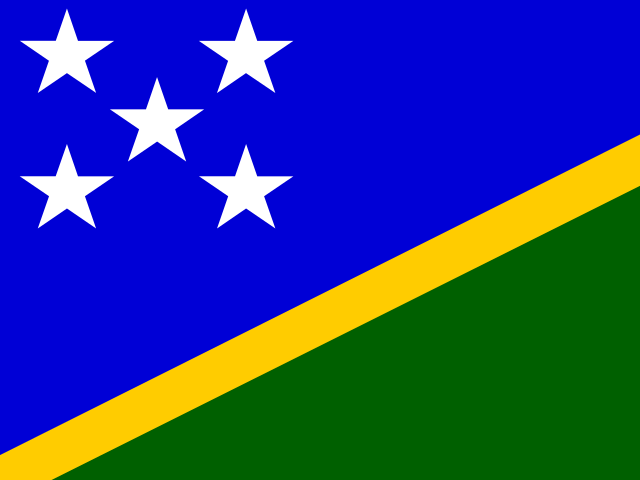
- Solomon Islands
- Vanuatu
- Papua New Guinea
- Micronesia
Solomon Islands. The Solomon Islands are made up of nearly 1,000 islands.
Science and nature
True or false: K is the symbol for potassium.
True. Potassium is K. Potassium reacts so fiercely with water that it bursts into lilac flames. K comes from its Latin name, kalium.
Name the element with the symbol Cu.
Copper. Copper slowly turns green outdoors. Cu comes from the Latin cuprum, after Cyprus, where copper was mined in ancient times.
Which element was once known by the Latin name natrium?
- Nitrogen
- Neon
- Nickel
- Sodium
Sodium. Sodium is a metal soft enough to cut with a knife. Its symbol Na comes from the Latin natrium.
True or false: Dilophosaurus could spit venom.
False. No fossil shows Dilophosaurus with venom or a neck frill. Both were made up for Jurassic Park.
Which part of your skeleton joins your spine to your legs?
- Skull
- Thigh bone
- Pelvis
- Spine
Pelvis. The pelvis is a bowl-shaped ring of bones in your hips.
Which element was once known by the Latin name plumbum?
- Platinum
- Phosphorus
- Potassium
- Lead
Lead. Romans made water pipes from lead, and plumbers are named after it. Pb comes from the Latin plumbum.
Put the Moon's phases in order, starting from a full Moon. Waning means shrinking. Gibbous means more than half lit: Full Moon, Last quarter, New Moon, Waning crescent, Waning gibbous.
Full Moon → Waning gibbous → Last quarter → Waning crescent → New Moon. From one full Moon to the next takes about 29 and a half days.
True or false: Your tongue can only taste sweet things with its tip.
False. The 'tongue map' is a myth. Taste buds all over your tongue pick up every basic taste.
The Plough is part of which constellation?
- Ursa Minor
- Cassiopeia
- Ursa Major
- Orion
Ursa Major. Ursa Major means the Great Bear. In America, the Plough is called the Big Dipper.
Name the element with the symbol Sn.
Tin. Bend a bar of tin and it makes a faint crackling sound called the tin cry. Sn comes from the Latin stannum.
True or false: Coelophysis ate meat.
True. Hundreds of Coelophysis skeletons were found together at Ghost Ranch in New Mexico.
Which part of a cell is the jelly where most chemical reactions happen?
- Mitochondria
- Chloroplast
- Cytoplasm
- Nucleus
Cytoplasm. Cytoplasm is the jelly inside a cell, where most chemical reactions happen.
History
True or false: Alexander Fleming discovered penicillin in 1889.
False. It was 1928. It went on to become one of the most important medicines ever found.
Put these in order, earliest first: Channel Tunnel opens, Great Pyramid of Giza built, Penny Black stamp issued, Storming of the Bastille.
Great Pyramid of Giza built (around 2560 BC) → Storming of the Bastille (1789) → Penny Black stamp issued (1840) → Channel Tunnel opens (1994). The Channel Tunnel opened about 4,600 years after the Great Pyramid of Giza was built.
Which came first?
- Eiffel Tower completed
- Victoria becomes queen
Victoria becomes queen. Victoria became queen in 1837, 52 years before the Eiffel Tower was completed.
In which year did Julius Caesar first land in Britain?
- 55 BC
- 75 BC
- 80 BC
- 35 BC
55 BC. He came back the next year with a bigger army, but went home again.
Which came first?
- Magna Carta sealed
- Thomas Becket killed
Thomas Becket killed. Thomas Becket was killed in Canterbury Cathedral in 1170, 45 years before Magna Carta was first sealed.
In which century were the first modern Olympic Games held?
- 18th century
- 19th century
- 17th century
- 20th century
19th century. The first modern Olympic Games were held in 1896, which is in the 19th century.
In which year did James Cook land at Botany Bay?
- 1795
- 1776
- 1820
- 1770
1770. Scientists on his ship found so many new plants there that it was named Botany Bay.
Words
Which word fills the gap? We had tea, and _____ we watched a film.
- then
- than
then. Then is about time, and both then and when have an e.
True or false: Danke is how you say thank you in German.
True. Danke is thank you in German. Danke schön is thank you very much. The usual reply is bitte, which also means please.
Which is spelt correctly?
- availabel
- available
- availible
- avaliable
available. Available ends in able, as in able to get.
Which language is this thank you from: "Grazie"?
- Portuguese
- Spanish
- Italian
- Swedish
Italian. Grazie mille, a thousand thanks, is how Italians say thanks a lot.
Spot the right spelling.
- immediatly
- imediately
- immedietly
- immediately
immediately. Immediately is immediate plus ly. Keep the e.
How do you say hello in Welsh?
- Olá
- Privet
- Yia sou
- Shwmae
Shwmae. Shwmae is a friendly Welsh hello. Helo works too, and bore da means good morning.
How do you say thank you in Russian?
- Dziękuję
- Danke
- Spasibo
- Grazie
Spasibo (Спасибо). Spasibo grew from an old phrase meaning God save you.
Which is spelt correctly?
- rhime
- rhyme
- ryhme
- ryme
rhyme. Rhyme starts r, h, y, just like rhythm.
How to use these questions
Read the questions out and tap Show answer to check each one, or press Play and let the game ask them and keep the score. To see every answer at once, switch on Show all answers at the top of the list. The page also prints on A4 paper from your browser's own Print command: the questions come first and the answers follow on a separate sheet.
Play it properly
- Short rounds of ten questions that fit before tea or between lessons.
- Pictures, sounds and read-aloud questions for younger players.
- It remembers what you got wrong and brings it back until it sticks.
- No accounts and no sign-up. Progress stays on your device.
More quizzes
By age
- Quiz questions for 5 year olds
- Quiz for 6 year olds with answers
- Quiz for 7 year olds
- Quiz for 8 year olds
- Quiz for 9 year olds with answers
- Quiz for 10 year olds
- Quiz for 11 year olds with answers
- Quiz for 12 year olds with answers
- Quiz for 13 year olds with answers
- Quizzes for 8-10 year olds with answers
- Quizzes for 10-12 year olds with answers
- General knowledge quiz for 11-14 year olds
By topic
- Flag quiz for kids and grown-ups
- Capital cities quiz for kids
- Times tables practice
- Maths quiz for kids
- Spelling test for Year 1 to Year 6
- Dinosaur quiz for kids
- Space quiz for kids
- Periodic table quiz for kids
- History quiz for kids
- Famous landmarks quiz for kids
- World map quiz for kids: find the country
- Animal quiz for kids
- Hello in different languages