- Quizzoo
- Children's quiz questions and answers
- Quiz for 10 year olds
Quiz for 10 year olds
Fractions of amounts, flags that are easy to mix up, history put in order, and words from the Year 5 and 6 spelling list. This quiz for 10 year olds has every answer on the page, and one tap starts the real game.
Play this quizFree to play. No sign-up, nothing to install.
Print this quiz (PDF)Answers (PDF)
Numbers
In 5,130, what is the value of the digit 3?
- 3
- 30
- 300
- 3,000
30. The 3 is in the tens place, so its value is 30.
True or false: 419 rounded to the nearest 10 is 420.
True. The ones digit is 9. 5 or more rounds up, so 419 becomes 420.
Put these in order, smallest first: 4,952, 4,925, 4,295, 4,259.
4,259 → 4,295 → 4,925 → 4,952. Compare the thousands first, then the hundreds, then the tens.
Round 685 to the nearest 10.
690. The ones digit is 5. 5 or more rounds up, so 685 becomes 690.
In 9,643, what is the value of the digit 4?
- 4
- 40
- 400
- 4,000
40. The 4 is in the tens place, so its value is 40.
True or false: 1/3 of 120 = 30.
False. 1/3 of 120 = 40. To find a third, divide by 3: 120 ÷ 3 = 40.
What is 3/10 of 60?
18. Find 1/10 first: 60 ÷ 10 = 6. Then 3 lots of 6 make 18.
What is 7.9 + 1.87?
9.77. Line up the decimal points: 7.90 + 1.87 = 9.77.
What is 8.5 + 4.21?
12.71. Line up the decimal points: 8.50 + 4.21 = 12.71.
The world
True or false: This is the flag of Malaysia.
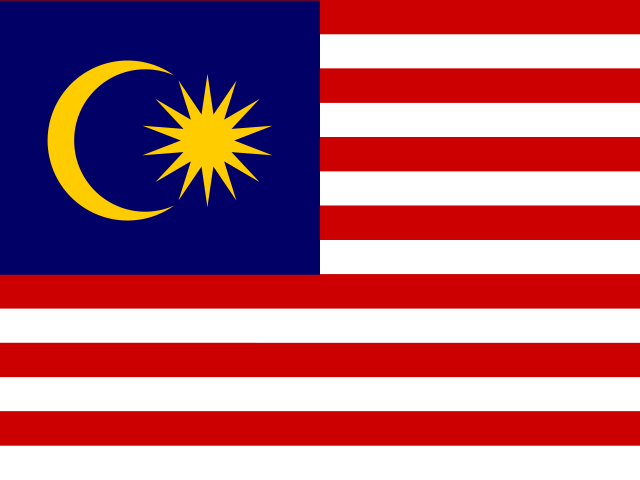
True. It's Malaysia. Malaysia's flag has 14 stripes: one for each of its 13 states and one for the federal government.
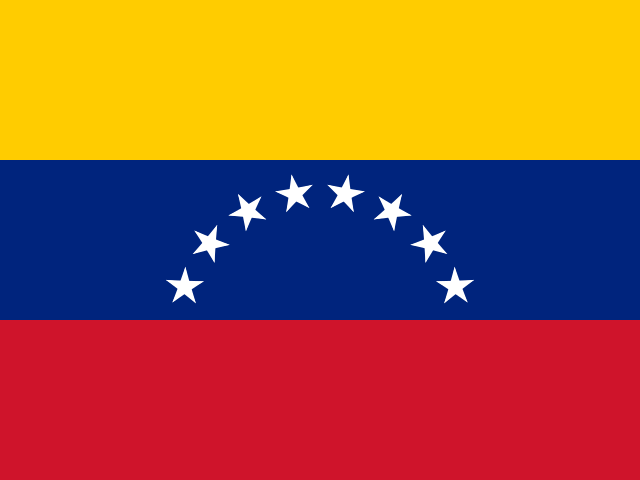
Which country's flag is this?
- Peru
- Venezuela
- Colombia
- Ecuador
Venezuela. Angel Falls in Venezuela is the tallest waterfall in the world.
What is the capital of the Philippines?
- Copenhagen
- Seoul
- Wellington
- Manila
Manila. The Philippines flies its flag with the red stripe on top in times of war.
What is the capital of Nepal?
- Pretoria
- Hanoi
- Kathmandu
- Mexico City
Kathmandu. Nepal's is the only national flag that doesn't have four sides.
Put these countries in order from north to south. Start with the one furthest north: Finland, Ireland, Portugal, Switzerland.
Finland → Ireland → Switzerland → Portugal. In the far north of Finland, inside the Arctic Circle, the summer sun does not set for weeks on end.
What is the capital of Afghanistan?
- Kyiv
- Copenhagen
- Ankara
- Kabul
Kabul. Afghanistan is landlocked, but a thin strip of it, the Wakhan Corridor, reaches all the way to China.
Which country is Neuschwanstein Castle in?
- Monaco
- Switzerland
- Germany
- Netherlands
Germany. Neuschwanstein was built for King Ludwig II of Bavaria from 1869. It helped inspire Disney's Sleeping Beauty Castle.
True or false: This is the flag of Cameroon.
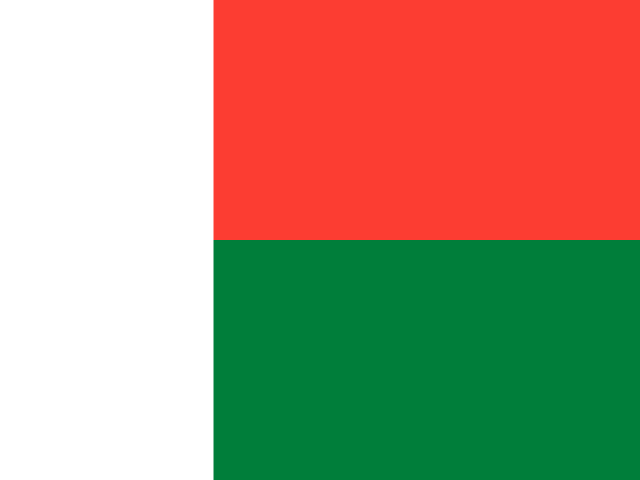
False. It's Madagascar. Madagascar is the natural home of lemurs, and most of its plants and animals are found nowhere else on Earth.
What is the capital of Slovakia?
- Kingston
- Bratislava
- Washington, D.C.
- Brussels
Bratislava. Slovakia became its own country in 1993, when Czechoslovakia split peacefully in two.
Science and nature
Which part of a plant has a tiny new plant waiting inside it?
- Seed
- Stem
- Roots
- Flower
Seed. Inside a seed is a tiny new plant, ready to grow.
True or false: Your heart is a muscle.
True. It is a special kind of muscle that keeps working, day and night, your whole life.
Which gas do plants give out that we need to breathe?
- Helium
- Carbon dioxide
- Neon
- Oxygen
Oxygen. Plants release oxygen as they make food from sunlight.
True or false: Neon is a liquid at room temperature (about 20 °C).
False. Neon is a gas. Neon glows orange-red when electricity runs through it. Its name comes from the Greek for new.
True or false: Bananas are a good source of potassium.
True. Bananas are very slightly radioactive, because a tiny part of their potassium is naturally radioactive. They are totally safe to eat.
Table salt is made of chlorine and which metal?
- Copper
- Iron
- Sodium
- Calcium
Sodium. Salt is sodium chloride. Alone, sodium is a reactive metal and chlorine is a poisonous gas.
Which country launched Sputnik 1, the first satellite?
- The Soviet Union
- The United States
- France
- China
The Soviet Union. Sputnik 1's beeping radio signal could be picked up by people all around the world.
Put these dinosaurs in order of size, smallest first: Argentinosaurus, Coelophysis, Compsognathus, T. rex.
Compsognathus → Coelophysis → T. rex → Argentinosaurus. Argentinosaurus weighed as much as several elephants. Compsognathus weighed less than a big dog.
Which is the hottest planet in our Solar System?
- Mars
- Earth
- Venus
- Mercury
Venus. Venus is farther from the Sun than Mercury, but its thick atmosphere traps heat like a blanket.
Which dinosaur had one big nose horn and long spikes around its frill?
- Baryonyx
- Dilophosaurus
- Styracosaurus
- Plateosaurus
Styracosaurus. Styracosaurus had one long horn on its nose and a frill edged with long spikes.
Which group of animals usually starts life in water with gills and grows lungs later?
- Fish
- Amphibians
- Reptiles
- Mammals
Amphibians. Frogs, toads and newts are amphibians. Their young, such as tadpoles, live in water.
Which of these is a dinosaur?
- Baryonyx
- Ichthyosaurus
- Pteranodon
- Mosasaurus
Baryonyx. Ichthyosaurs were sea reptiles shaped like dolphins. They gave birth to live young at sea.
History
True or false: The Black Death first reached England before Gutenberg built his printing press.
True. Black Death reaches England: 1348. Gutenberg's printing press: around 1440. Gutenberg built his printing press in around 1440. Before presses like his, most books in Europe were copied out by hand.
Put these in order, earliest first: First people on the Moon, Great Fire of London, Henry VIII becomes king, Magna Carta sealed.
Magna Carta sealed (1215) → Henry VIII becomes king (1509) → Great Fire of London (1666) → First people on the Moon (1969). People first walked on the Moon in 1969. Neil Armstrong went first. Buzz Aldrin followed him down the ladder about 20 minutes later.
True or false: The First World War began before the Battle of Waterloo was fought.
False. Battle of Waterloo: 1815. First World War begins: 1914. The First World War began in 1914. It lasted more than four years and drew in countries from around the world.
In which century was the Gunpowder Plot foiled?
- 17th century (the 1600s)
- 16th century (the 1500s)
- 18th century (the 1700s)
- 14th century (the 1300s)
17th century (the 1600s). The Gunpowder Plot was foiled in 1605, which is in the 17th century.
True or false: The telephone was first patented in the 16th century (the 1500s).
False. It was 1876, in the 19th century (the 1800s). Alexander Graham Bell patented it. His first call was to his assistant, Mr Watson, in another room.
In which century did the first person go into space?
- 19th century (the 1800s)
- 18th century (the 1700s)
- 21st century (the 2000s)
- 20th century (the 1900s)
20th century (the 1900s). The first person went into space in 1961, which is in the 20th century.
In which century did the Berlin Wall fall?
- 20th century (the 1900s)
- 18th century (the 1700s)
- 19th century (the 1800s)
- 21st century (the 2000s)
20th century (the 1900s). The Berlin Wall fell in 1989, which is in the 20th century.
Words
Which word fills the gap? We drove _____ the castle.
- passed
- past
past. Past means beyond, or time gone by. Passed is a verb: she passed the test.
True or false: 'Lightning', the flash in a storm, has an e after the t.
False. Lightning has no e. Lightening means making something lighter.
Only one of these is spelt right. Which?
- catagory
- catergory
- category
- categary
category. Category is cat, then ego, then ry.
Which word fills the gap? I _____ you to bring a coat.
- advice
- advise
advise. Advise is the verb, and its s sounds like a z.
Which spelling is right?
- que
- queu
- qeue
- queue
queue. Queue has four vowels in a row, and still sounds just like the letter q.
Which is spelt correctly?
- veicle
- vehicel
- vehical
- vehicle
vehicle. Vehicle has a quiet h after the e, and ends in cle.
True or false: 'Twelfth' has an f in it.
True. Twelve becomes twelfth: the v turns into an f.
Which word fills the gap? You need a _____ to drive a car.
- licence
- license
licence. In British English, licence with a c is the noun. License with an s is the verb.
How to use these questions
Read the questions out and tap Show answer to check each one, or press Play and let the game ask them and keep the score. To see every answer at once, switch on Show all answers at the top of the list. The page also prints on A4 paper from your browser's own Print command: the questions come first and the answers follow on a separate sheet.
Play it properly
- Short rounds of ten questions that fit before tea or between lessons.
- Pictures, sounds and read-aloud questions for younger players.
- It remembers what you got wrong and brings it back until it sticks.
- No accounts and no sign-up. Progress stays on your device.
More quizzes
By age
- Quiz questions for 5 year olds
- Quiz for 6 year olds with answers
- Quiz for 7 year olds
- Quiz for 8 year olds
- Quiz for 9 year olds with answers
- Quiz for 10 year olds
- Quiz for 11 year olds with answers
- Quiz for 12 year olds with answers
- Quiz for 13 year olds with answers
- Quizzes for 8-10 year olds with answers
- Quizzes for 10-12 year olds with answers
- General knowledge quiz for 11-14 year olds
By topic
- Flag quiz for kids and grown-ups
- Capital cities quiz for kids
- Times tables practice
- Maths quiz for kids
- Spelling test for Year 1 to Year 6
- Dinosaur quiz for kids
- Space quiz for kids
- Periodic table quiz for kids
- History quiz for kids
- Famous landmarks quiz for kids
- World map quiz for kids: find the country
- Animal quiz for kids
- Hello in different languages