- Quizzoo
- Children's quiz questions and answers
- Quiz for 11 year olds with answers
Quiz for 11 year olds with answers
Percentages and negative numbers, capital cities, which elements are solids, liquids or gases, and the human body. This quiz for 11 year olds with answers suits the last year of primary school and the summer before secondary.
Play this quizFree to play. No sign-up, nothing to install.
Print this quiz (PDF)Answers (PDF)
Numbers
What is 10% of 480?
- 24
- 10
- 470
- 48
48. 10% means divide by 10: 480 ÷ 10 = 48.
What is 20% of 200?
- 40
- 20
- 160
- 180
40. 10% of 200 is 20, so 20% is double that: 40.
Put these in order, smallest first: −12, −2, −4, 7.
−12 → −4 → −2 → 7. The further below zero, the smaller the number, so −12 is the smallest here.
What is −1 + 12?
11. Start at −1 on a number line and count 12 to the right: 11.
True or false: 3/5 of 55 = 22.
False. 3/5 of 55 = 33. Find 1/5 first: 55 ÷ 5 = 11. Then 3 lots of 11 make 33.
What is 1/5 of 115?
- 110
- 46
- 23
- 92
23. To find a fifth, divide by 5: 115 ÷ 5 = 23.
What is 7.4 + 3.82?
- 11.32
- 4.56
- 11.12
- 11.22
11.22. Line up the decimal points: 7.40 + 3.82 = 11.22.
What is 1.3 + 4.29?
5.59. Line up the decimal points: 1.30 + 4.29 = 5.59.
True or false: 35 × 11 = 385.
True. Divide to find it: 385 ÷ 35 = 11, because 35 × 11 = 385.
The world
What is the capital of Zimbabwe?
- Yaoundé
- Harare
- Antananarivo
- Addis Ababa
Harare. Great Zimbabwe is a ruined stone city built centuries ago. The country is named after it.
Which continent is Bulgaria in?
Europe. Bulgaria's eastern coast is on the Black Sea.
Which country's flag is this?
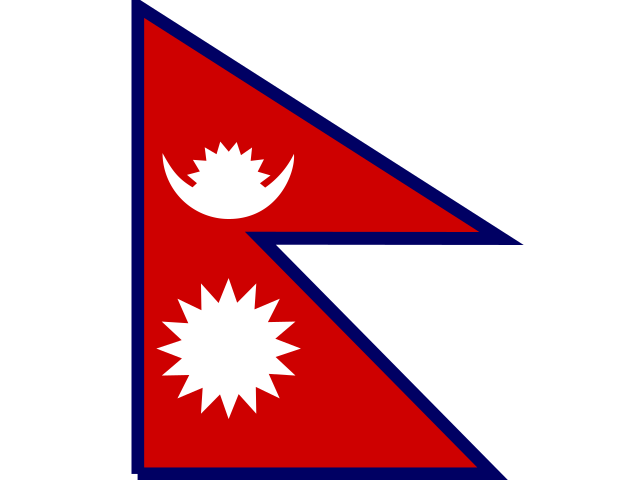
- Thailand
- Philippines
- Afghanistan
- Nepal
Nepal. Nepal's is the only national flag that doesn't have four sides.
Belgrade is the capital of which country?
- Netherlands
- Russia
- Croatia
- Serbia
Serbia. Serbia is one of the world's biggest growers of raspberries.
True or false: Buckingham Palace is in the United Kingdom.
True. Buckingham Palace is in the United Kingdom. Buckingham Palace became the monarch's official London home in 1837, when Queen Victoria moved in.
True or false: The capital of Tanzania is Dar es Salaam.
False. It's Dodoma. Dodoma is the capital. Dar es Salaam is the biggest city and used to be the capital.
Put these in order, oldest first: Burj Khalifa, Machu Picchu, Mount Rushmore carving, White House.
Machu Picchu → White House → Mount Rushmore carving → Burj Khalifa. Oldest first: Machu Picchu (about 1450), White House (1800), Mount Rushmore carving (1927 to 1941), Burj Khalifa (2010).
Which continent is Costa Rica in?
North America. Costa Rica has had no army since 1948.
True or false: This is the flag of Uganda.
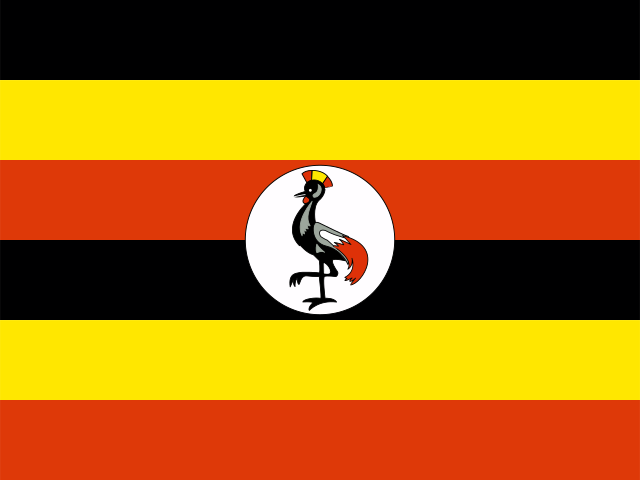
True. It's Uganda. Lake Victoria, which Uganda shares with Kenya and Tanzania, is the biggest lake in Africa and a source of the Nile.
Science and nature
The batteries in most phones are named after which metal?
- Lead
- Lithium
- Copper
- Zinc
Lithium. Lithium-ion batteries power most phones, laptops and electric cars.
True or false: Copper is a non-metal.
False. Copper is a metal. Copper slowly turns green outdoors. Cu comes from the Latin cuprum, after Cyprus, where copper was mined in ancient times.
What holds your body up and keeps the soft parts inside you safe?
- Stomach
- Skeleton
- Skin
- Brain
Skeleton. Babies are born with around 300 bones. Adults have 206, because some join together.
Which group of animals feeds its babies on milk?
- Reptiles
- Birds
- Mammals
- Fish
Mammals. Every mammal mother makes milk for her young, from mice to blue whales.
What is it called when animals travel a long way as the seasons change?
- Pollination
- Hibernation
- Metamorphosis
- Migration
Migration. Swallows fly from Britain to southern Africa for the winter, then come back in spring.
At room temperature (about 20 °C), is nickel a solid, a liquid or a gas?
- Solid
- Liquid
- Gas
Solid. Nickel is one of the few metals a magnet pulls on, along with iron and cobalt.
At room temperature (about 20 °C), is sodium a solid, a liquid or a gas?
- Solid
- Liquid
- Gas
Solid. Sodium is a metal soft enough to cut with a knife. Its symbol Na comes from the Latin natrium.
In a food chain, what is an animal that eats plants or other animals called?
- A consumer
- A fossil
- A producer
- A decomposer
A consumer. Animals cannot make their own food, so every animal in a food chain is a consumer.
How strong is gravity on the Moon, compared with Earth?
- Twice as strong
- About half as strong
- Exactly the same
- About a sixth as strong
About a sixth as strong. On the Moon, you could jump about six times higher than you can on Earth.
True or false: Baryonyx ate meat.
True. Baryonyx was found in a Surrey clay pit in 1983, with fish scales in its stomach.
Which element is the lightest of all?
- Helium
- Hydrogen
- Lithium
- Oxygen
Hydrogen. A hydrogen atom is the simplest there is, usually just one proton and one electron.
Who was the first British person in space?
- Helen Sharman
- Patrick Moore
- Tim Peake
- Michael Foale
Helen Sharman. Helen Sharman was a chemist who answered a radio advert. In 1991 she flew to the Mir space station.
History
Which of these happened first?
- Henry VIII becomes king
- Victoria becomes queen
- Charles III is crowned
- First people on the Moon
Henry VIII becomes king. Henry VIII became king in 1509. He married six times. Three of his children went on to rule England.
True or false: The Battle of Waterloo was fought in the 19th century.
True. It was 1815, in the 19th century. The Duke of Wellington and his allies finally beat Napoleon, in what is now Belgium.
In which century did the Great Fire of London break out?
- 17th century
- 16th century
- 18th century
- 19th century
17th century. The Great Fire of London broke out in 1666, which is in the 17th century.
Put these in order, earliest first: Channel Tunnel opens, Eiffel Tower completed, Gunpowder Plot foiled, Roman conquest of Britain begins, Stonehenge's big stones raised.
Stonehenge's big stones raised (around 2500 BC) → Roman conquest of Britain begins (AD 43) → Gunpowder Plot foiled (1605) → Eiffel Tower completed (1889) → Channel Tunnel opens (1994). The Gunpowder Plot was foiled in 1605. Guy Fawkes was caught under Parliament with barrels of gunpowder. Bonfire Night remembers it on 5 November.
True or false: Alexander Fleming discovered penicillin after the Berlin Wall fell.
False. Penicillin discovered: 1928. Berlin Wall falls: 1989. The Berlin Wall fell in 1989. It had split the city for 28 years. Germany became one country again the following year.
Which came first?
- Elizabeth I becomes queen
- Mayflower sails to America
Elizabeth I becomes queen. Elizabeth I became queen in 1558, 62 years before the Mayflower sailed to America.
True or false: Nelson Mandela became president of South Africa in the 19th century.
False. It was 1994, in the 20th century. He had spent 27 years in prison and was the country's first Black president.
Words
Which spelling is right?
- reighn
- reign
- rayne
- riegn
reign. Reign has a silent g, just like sign and foreign.
Only one of these is spelt right. Which?
- fruit
- froot
- frute
- furit
fruit. Fruit has ui in the middle, like suit and juice.
True or false: Yia sou is how you say hello in Portuguese.
False. Yia sou is hello in Greek. Yia sou means health to you. Greeks say yia sas to be polite, or to greet a group.
Which language is this hello from: "Merhaba"?
- Italian
- Hindi
- Turkish
- Greek
Turkish. Merhaba came into Turkish from the Arabic marhaba. Turkish has used the Latin alphabet since 1928.
True or false: Hoi is how you say hello in Greek.
False. Hoi is hello in Dutch. Dutch speakers say hallo, or hoi between friends. Dutch and German are close cousins.
True or false: Hej is how you say hello in Swedish.
True. Hej is hello in Swedish. Hej sounds like the English hey. When it is time to go, Swedes say hej då.
Which is spelt correctly?
- physicle
- phisical
- fysical
- physical
physical. Physical starts with ph, which sounds like f. It comes from Greek.
Which word fills the gap? Camels can cross the hot _____.
- dessert
- desert
desert. A desert, with one s, is a very dry place.
How to use these questions
Read the questions out and tap Show answer to check each one, or press Play and let the game ask them and keep the score. To see every answer at once, switch on Show all answers at the top of the list. The page also prints on A4 paper from your browser's own Print command: the questions come first and the answers follow on a separate sheet.
Play it properly
- Short rounds of ten questions that fit before tea or between lessons.
- Pictures, sounds and read-aloud questions for younger players.
- It remembers what you got wrong and brings it back until it sticks.
- No accounts and no sign-up. Progress stays on your device.
More quizzes
By age
- Quiz questions for 5 year olds
- Quiz for 6 year olds with answers
- Quiz for 7 year olds
- Quiz for 8 year olds
- Quiz for 9 year olds with answers
- Quiz for 10 year olds
- Quiz for 11 year olds with answers
- Quiz for 12 year olds with answers
- Quiz for 13 year olds with answers
- Quizzes for 8-10 year olds with answers
- Quizzes for 10-12 year olds with answers
- General knowledge quiz for 11-14 year olds
By topic
- Flag quiz for kids and grown-ups
- Capital cities quiz for kids
- Times tables practice
- Maths quiz for kids
- Spelling test for Year 1 to Year 6
- Dinosaur quiz for kids
- Space quiz for kids
- Periodic table quiz for kids
- History quiz for kids
- Famous landmarks quiz for kids
- World map quiz for kids: find the country
- Animal quiz for kids
- Hello in different languages